Overview
M.Sc. Nursing is a two-year postgraduate program offering different specialities in affiliation with Rajiv Gandhi University of Health Sciences. It is recognised by the Indian Nursing Council, the Karnataka State Nursing Council, and approved by the Government of Karnataka.
This program is designed to prepare graduates to step into roles as nurse specialists, consultants, educators and administrators across a wide range of healthcare settings.
Course Objectives
On completing the two-year M.Sc. Nursing program graduates will be able to:
- Apply core concepts, theories and principles of nursing sciences
- Demonstrate advanced competence in clinical nursing practice
- Contribute effectively as nurse specialists
- Communicate with clarity and build strong interpersonal relationships
- Lead with confidence and function as nurse educators and managers
- Conduct nursing research, interpret findings and apply insights to practice
- Plan and implement meaningful improvements in nursing practice and healthcare delivery
- Work collaboratively with professionals across disciplines
- Continue learning for personal and professional growth
Specialisations offered
Medical Surgical Nursing
which offers various subspecialties such as Ortho, Neuro, Oncology, ICU, Cardiothoracic Nursing, etc., which focuses on the care of adult patients across varied clinical conditions.
Community Health Nursing
Integrates primary healthcare, public health and nursing practices to support individuals, families and communities, which provide preventive, promotive and curative health services.
Obstetrics and Gynaecology Nursing
Centres on women’s health during pregnancy, labour, postpartum care and conditions related to the female reproductive system.
Child Health Nursing
Child Health Nursing or Pediatric Nursing is the specialised care of infants, children and adolescents from birth.
Mental Health Nursing
Mental Health Nursing involves the delivery of nursing care for individuals with mental health conditions, focusing on building therapeutic relationships, supporting recovery and advocating for patients with issues from depression to severe illness.
Clinical Training
Students receive extensive clinical exposure in leading hospitals in Bengaluru, including:
• P. D. Hinduja Sindhi Hospital
• Sri Bhagwan Mahaveer Jain Hospital
• Vision India Mental Health Nursing
• Jayadeva Institute of Cardiology
• Indira Gandhi Institute of Child Health
• Ulsoor & D J Halli Maternity Centre
• Bettahalasur, K Narayanapura Primary Health Centre
Eligibility
Candidates applying for the Post Basic B.Sc. Nursing program must meet the following requirements:
- The candidate must have completed B.Sc. Nursing (Basic), Post Basic B.Sc. Nursing, or Post Certificate B.Sc Nursing with a minimum of 55% from Rajiv Gandhi University of Health Sciences or any university recognised as equivalent by RGUHS.
- Candidates with B.Sc. Nursing (Basic) must have a minimum of one year of work experience in a hospital, a nursing educational institution or a community health setting.
- Candidates with a Post Basic B.Sc. Nursing degree do not require experience after graduation.
- The candidate must be a registered nurse and registered midwife with the State Nursing Council.
- The candidate must be medically fit.
Course Structure
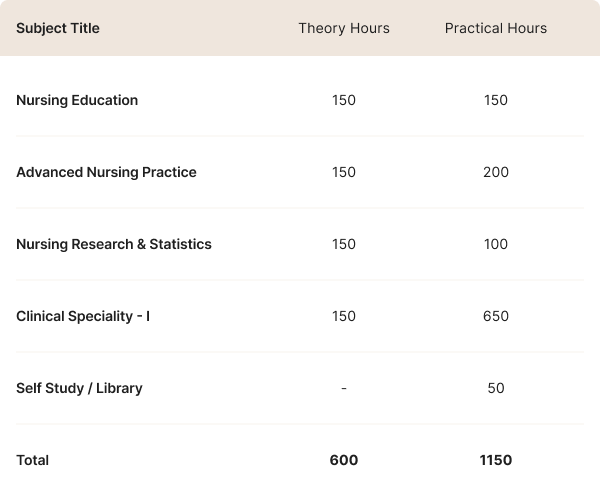
First Year
- Nursing Education
- Advanced Nursing Practice
- Nursing Research and Statistics
- Clinical Speciality I
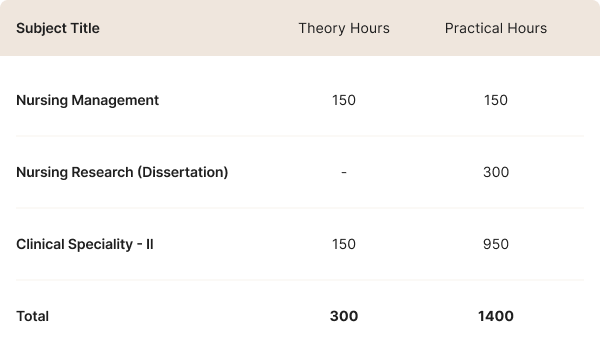
Second Year
- Nursing Education
- Nursing Research (Dissertation)
- Clinical Speciality II
Career Pathways
Clinical and advanced roles:
- Expert in a specific area
- Nurse practitioner
- ICU, NICU, OT Nurse
- Infection Control Nurse
- Home Care Nurse
Education:
- Nurse Educator/Instructor
- Assistant Professor
- Associate Professor
- Nursing Tutor/Clinical Facilitator
Management and Administration
- Nurse Manager/Supervisor
- Director of Nursing
- Nursing Administrator
Research & Other Field:
- Clinical Research Nurse
- Nursing Consultant
- Corporate/Industry role
Syllabus
First Year
Second Year